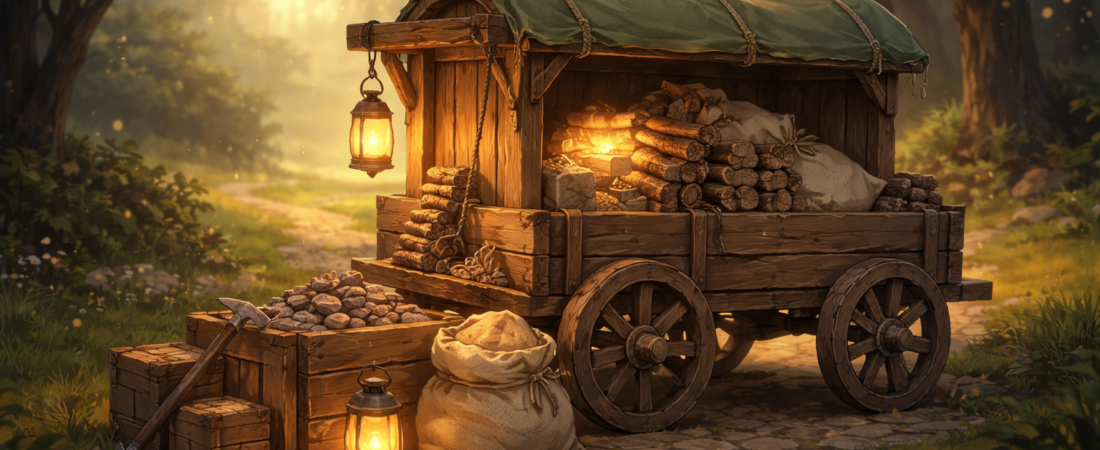
A reflective cart strategy for SwordxStaff
In SwordxStaff, it’s easy to feel pressure to build your cart for the first season instead of the long run.
Big numbers.
Full bars.
The comforting sense that you’re “keeping up.”
This guide isn’t for that feeling.
This is for players who are willing to feel slightly underpowered early so they don’t have to fight the system later. It’s a cart strategy built around patience, rhythm, and letting the math do its quiet work over time.
You won’t spike early.
You will stabilize early.
And that difference matters more than it sounds.
Why Starting Slow Is the Point
Most players upgrade their cart the same way they tidy a room—everything gets a little attention, nothing gets finished.
It feels responsible.
It also caps your future.
This approach does something less intuitive: it pushes hard on cart efficiency early, even when the short-term returns feel underwhelming. Instead of asking “What helps me right now?” the question becomes:
“What keeps paying me back later?”
The early seasons reflect that choice:
- Resources feel tight
- Progress looks unimpressive next to balanced builds
- There’s a temptation to correct course
Resisting that temptation is the entire strategy.
Once efficiency is in place, the cart stops being something you manage and starts being something that quietly supports you every season without extra effort.
That’s the payoff.
Choosing What Not to Level
The fastest way to exhaust yourself is trying to grow everything at once.
A cart works best when it has a clear spine.
Some resources carry the weight of your production.
Others exist to support them.
Mixing those roles creates confusion and cost spikes that don’t translate into meaningful output.
A clean hierarchy looks like this:
- Core resources do the heavy lifting
- Support resources fill gaps and smooth progression
What matters most isn’t the exact list — it’s maintaining a noticeable gap between those two groups.
When your core resources stay meaningfully ahead of your support ones, production bonuses begin to stack in a way you can actually feel. When everything stays even, growth turns into noise.
This isn’t neglect.
It’s pacing.
Let Your Actions Match Your Intentions
A cart doesn’t exist in isolation.
It reflects how you play.
One of the most subtle mistakes players make is upgrading one thing while doing another. The cart points in one direction. Your stamina goes somewhere else.
That split focus creates friction:
- Combat power lags behind expectations
- Seasonal progress feels oddly flat
- Nothing seems broken, but nothing feels good either
The fix is boring and effective:
If your cart is leaning into something, your stamina should follow.
When gathering and upgrading move in the same direction, progress feels steady instead of strained. The system rewards alignment more than activity.
Why Bonuses Deserve More Attention Than Levels
It’s easy to fixate on cart levels because they’re visible and satisfying.
But production doesn’t scale evenly.
Behind the scenes, bonuses do more work than most players give them credit for.
When one resource is sitting on a strong production bonus and another isn’t, upgrading them equally doesn’t produce equal results. One multiplies your effort. The other just adds to it.
Leaning into high-bonus resources does two things at once:
- Increases real hourly output
- Improves seasonal growth efficiency
You’re not grinding harder — you’re choosing where the math is already on your side.
The Upgrades That Quietly Stop Mattering
Not all upgrades are meant to grow with you forever.
Some look important early because any increase feels meaningful. Later on, those same upgrades struggle to keep up with how fast everything else scales.
Skill experience tied to flat values is one example. It helps at the beginning, but as class changes and higher-tier abilities come online, its impact fades while costs continue climbing.
Pet-related production upgrades fall into a similar category. They technically scale, but the return becomes so small that each new level feels symbolic rather than useful.
Because of this, it’s perfectly reasonable to let certain upgrades settle early while allowing your core production resources to keep pulling ahead.
The resulting imbalance isn’t accidental — it’s a reflection of what actually scales.
Small Habits That Protect Your Progress
Even a well-built cart can bleed value through neglect.
A few things to stay aware of:
- Storage fills faster than most people expect
Once it caps, production doesn’t pause — it disappears. - Temporary bonuses are easy to forget, especially if you’re not spending
The ones you do have access to should influence where you place your smaller upgrades.
These aren’t exciting decisions, but they prevent quiet losses that add up over time.
A Soft Ending, On Purpose
This cart strategy won’t make you feel powerful right away.
It won’t impress anyone scrolling through early-season rankings.
What it will do is remove pressure.
- Pressure to constantly rebalance
- Pressure to chase every upgrade
- Pressure to fix things that aren’t broken
If the early game feels calm but slightly uncomfortable, you’re probably on the right path.
Some systems reward urgency.
This one rewards consistency.
And consistency, over enough seasons, becomes its own kind of strength.