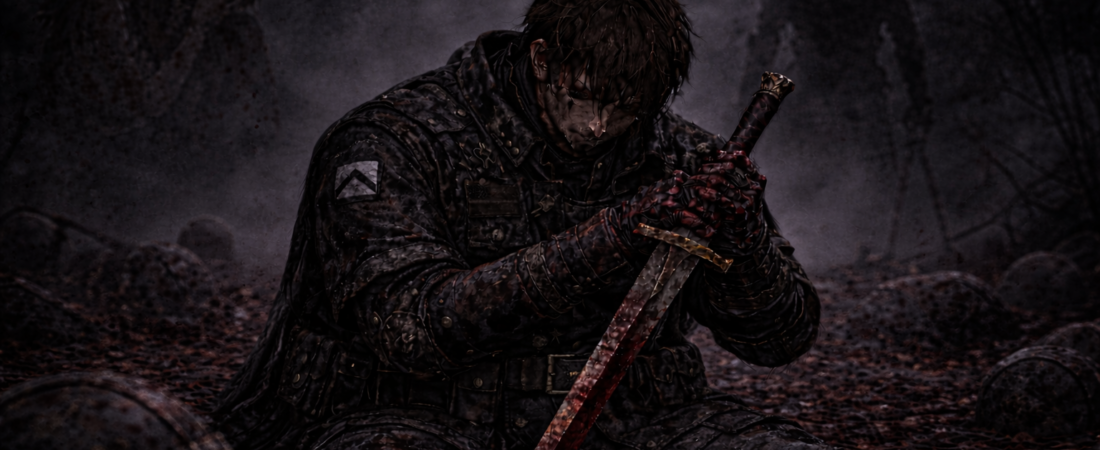
The First Thing I Took
Yaawn…
My blurry vision slowly comes into focus as the smell of last night’s campfire, sweat, and morning dew pulls me awake. I cover my eyes from the sun’s glare and sit up, letting the world settle.
Around me, the camp stirs quietly. Some move from bedroll to bedroll, shaking others awake. Some pack. Some check gear for the third or fourth time. There’s no laughter. No idle talk.
When I finally stand, I fall in with the others preparing to move out.
No one says much. The nerves are too close to the surface.
Everyone here is a villager—conscripted or desperate enough to enlist. No one who left before us ever came back. We were pulled from our homes and shoved toward the frontlines, meat for the grinder that is war. Most of us come from small countryside villages. We don’t know who we’re fighting or why. All anyone thinks about is making it back in one piece. Seeing their families again.
I don’t have that.
I grew up a homeless orphan, roaming the slums and taking whatever dirty work I could find. Stealing coin purses from nobles who wouldn’t notice. Persuading people to repay debts to the gang that ran the district. I was always decent at fighting—only got better with time.
The enlistment age is eighteen in most kingdoms. In Ashmere, it’s sixteen. For orphans, they take anyone who looks fourteen.
War here isn’t a tragedy. It’s an industry. Contracts pass from hand to hand, and as long as the coin flows, the blood keeps spilling.
Most of us—fourteen to eighteen—were collected by the Helios gang and sold forward as mercenaries. Fresh bodies, filtered in from villages and slums alike.
“Prepare to move out.”
The call ripples across the camp.
I tuck my journal away and step into formation.
We march for hours beneath the trees. The forest thins gradually, the light changing. The mercenaries ahead grow sharper, quieter. Something is wrong.
Then I see it.
A clearing opens beyond the tree line. We’re still under cover, but the sound reaches us first—metal on metal, screaming, the wet thud of bodies hitting the ground.
Beyond the field, thousands of soldiers collide in a writhing mass of steel and blood.
“Charge!”
The word shatters whatever hesitation remains.
We surge forward, slamming into the rear of one army. I jump over fallen bodies, slide through mud slick with blood. Shields collide ahead of me. I shove into the back of a comrade holding formation and stab from his side, using his shield as cover.
The line breaks.
Everything becomes noise and motion. Soldiers push through, scatter, clash in fragments. I step back, then forward again, slashing, blocking, surviving.
I raise my blade and bring it down with everything I have.
It sticks.
The steel jams between a man’s neck and shoulder, grinding against muscle and bone. I kick him away, wrenching the blade free as blood sprays across my hands and face.
I turn—
—and suddenly I’m watching a child wobble forward, taking one unsteady step before falling into waiting arms.
The image doesn’t belong to me.
My chest tightens. My heart stutters. Something presses against my thoughts, heavy and intimate and wrong.
I stab again. This time the blade sinks cleanly into a throat.
Blood coats my armor. My face.
Another memory floods in—the warmth of a woman’s cheek beneath my hand, the softness of her lips as they meet mine.
Strength surges through my limbs.
Not earned. Not asked for.
It fills me.
My muscles tighten, expand, move before I fully think. Panic claws at my chest as I push forward, striking, searching for the next shape that isn’t mine. Time smears. Sound dulls. My hands keep moving.
Then something slams into my face.
A helmet crashes across my cheek, sending me hard into the ground. The world tilts. I roll onto my back, vision swimming.
They stand over me, blade raised.
I stare into their unfocused eyes as steel comes down.